Why Your Daily Creative Practice Keeps Falling Apart: Working With Invisible Friction
When we want to build a daily creative habit, we tend to focus entirely on willpower. We tell ourselves that we just need more discipline. But from a psychological and somatic perspective, discipline isn't the problem. The real culprit is invisible friction and decision fatigue.
In this blog post, I’m cutting through the "shoulds" to look at:
Why your brain resists starting and how to lower the barrier to entry.
The 1-to-10 capacity check-in to ensure you aren't pushing through burnout.
Practical, low-friction habits you can stack into your existing day.
How to stop overshooting and start building a sustainable, realistic practice.
Unconscious Rules
We carry internalized "shoulds" about what a creative practice must look like. But when we do not zoom out to see where these rules come from, we accidentally design a routine that creates immediate resistance.
Our brains are wired to conserve energy. If your creative space is buried in a cupboard, or if you sit down at your desk with a pile of unresolved projects to choose from, your subconscious senses the "work" required just to get started. Faced with too many micro-decisions, the system chooses the path of least resistance: procrastination.
Cost of Micro-Decisions
If you sit down in the morning and have to choose between five different projects, or dig supplies out of a cupboard, your brain experiences decision fatigue. Too many choices equal zero action.
Reduce the friction by setting out one open journal and one pen the night before. All you have to do is sit down with your coffee and start writing. A sustainable practice bends to accommodate your baseline. It doesn't demand that you perform through exhaustion.

1-to-10 Capacity Check-In
Before you create, ask yourself:
Where is my frustration or overwhelm level right now on a scale of 1 to 10?
If you are already at a 5, forcing yourself to do an elaborate, messy setup will push your system over the edge. You will start associating your practice with stress.
More importantly, check in with your capacity before you begin. Forcing a complex, high "mess" project when your nervous system is already sitting at a 5 out of 10 for daily overwhelm is a recipe for blowout. Subconsciously, you might begin to associate your creative space with frustration.
Finding Growth at the Edge
There is a nuanced balance to strike here. While we need to honour our limits, a little bit of stress is actually okay—and even necessary—if we have the capacity for it. This is how we build capacity. By creating a simulation within a contained space, whether in your creative practice, a therapy session, or a gym class, you can safely look for your edge.
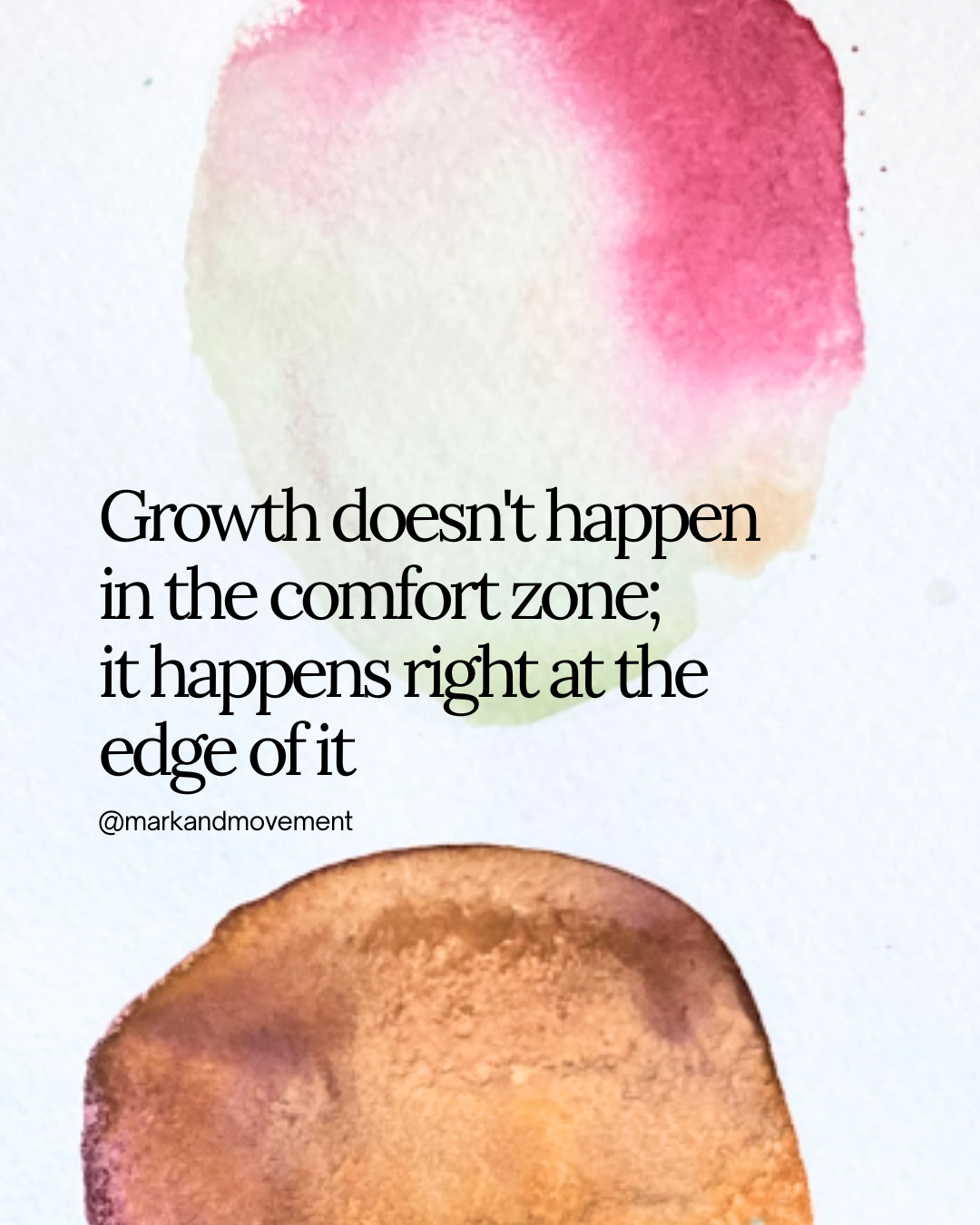
Growth doesn't happen in the comfort zone; it happens right at the edge of it. This is why mapping your energy and staying aware of what is happening inside—your interoception—is so vital. It lets you know exactly where you have some wiggle room.
When we try to create habits, we often overshoot because our eyes are bigger than our stomachs. We fail, and then we create a story that says "I always do this!"
But the reality is that you are simply not being realistic or compassionate about your capacity in that moment. When you get in contact with your true baseline and are honest with yourself, you take the pressure off. You stop forcing things, and you find more ease, room, and peace within yourself.
Map the Art to the Energy
Create a menu of options based on your daily internal capacity:
1–3 (Low stress): Space for complex or messy projects.
4–6 (Moderate stress): Keep it simple. Pre-set journaling or doodling or pick up a project that is already in progress.
7–10 (High stress): No art today. And that is okay. Switch to an intentional stroll or breathing to regulate your nervous system first. Or heck, go do something nice for yourself, whatever that looks like for you!.
This is what we are actually trying to cultivate with a creative habit: more awareness and a deeper connection to our vast, mysterious inner world. It can feel scary, uncertain, or chaotic, but what if we stepped in slowly? What if we met ourselves where we are at—like a friend bringing you soup when you are sick—and let ourselves truly be cared for? Not pushed, not "shoulded."
Practical Steps to Reduce Friction
Because every person is unique, your approach should be tailored to your own life. Consider these ways to lower the barrier to entry:
Set yourself up: If you have a home gym, why not have a dedicated art spot? This could look like keeping art materials in a tray you can easily move.
Prepare the night before: If opening a journal to a fresh page feels like a barrier, set your space up before you go to sleep.
Know thyself: Determine if you are a morning or night person. Journal about what a perfect day looks like, then reduce your desired time by 90% and start with that 10% version until it feels like a breeze.
Habit stack: Tack your creative habit onto something you already do every day. For example, journaling while waiting for morning coffee to brew.
Perform a life audit: Track your movements through the day to see where you could realistically tack on creativity.
Be realistic: Some days it just won't happen. Be flexible and realistic with your capacity; your nervous system will thank you for it.
Evaluate your trade-offs: Consider what you are holding onto and if it is life-giving or life-depleting. Sometimes you have to sacrifice something to achieve what you want.
Befriending Internal Boundaries
This list is not definitive. It is about awareness and connection to your vast, mysterious, and sometimes chaotic inner world. Stepping in slowly and meeting yourself where you are is radical because it challenges the "shoulds" of external systems. It is a radical act because it means diving into your internal system, which often goes against years of conditioning from external systems based on consumption, performance, and productivity. It is time to challenge the "shoulds" living with you, holding your creative lifeforce hostage.
Hi, I’m Mary-Helen and I hope you found this blog helpful. As a Transpersonal Art Therapist and recovering perfectionist, I help people stop fighting their own internal boundaries and start honouring them. If you are tired of setting up elaborate, rigid rules that end in frustration and feeling like you are 'doing it wrong,' I am here to help you identify and reduce the invisible friction. Find out more here.